Download Advanced VMware Cloud Foundation 9.0 vSphere Kubernetes Service.3V0-24.25.Actual4Test.2026-11-10.98q.vcex
| Vendor: | VMware |
| Exam Code: | 3V0-24.25 |
| Exam Name: | Advanced VMware Cloud Foundation 9.0 vSphere Kubernetes Service |
| Date: | Nov 10, 2026 |
| File Size: | 605 KB |
How to open VCEX files?
Files with VCEX extension can be opened by ProfExam Simulator.
Discount: 20%

Demo Questions
Question 1
Refer to the exhibit in the following StorageClass manifest, which field is used to specify the Volume Plugin driver used for the underlying storage array?
YAML
apiVersion: storage.k8s.io/v1
kind: StorageClass
metadata:
name: standard
provisioner: kubernetes.io/aws-ebs
parameters:
type: gp2
reclaimPolicy: Retain
allowVolumeExpansion: true
mountOptions:
- debug
volumeBindingMode: Immediate
- name
- provisioner
- parameters
- type
Correct answer: B
Explanation:
In a Kubernetes-based architecture like the vSphere Kubernetes Service (VKS) within VMware Cloud Foundation (VCF) 9.0, a StorageClass manifest serves as the definition for dynamic volume provisioning. The provisioner field is the mandatory attribute that determines which specific volume plugin or driver is invoked to create the underlying storage resource. In the provided exhibit, the string provisioner: kubernetes.io/aws- ebs specifies that the AWS Elastic Block Store (EBS) driver is the orchestrator for the lifecycle of the volumes associated with this class.In a standard on-premises VCF 9.0 deployment, the provisioner field typically points to csi.vsphere.vmware.com, identifying the vSphere Container Storage Interface (CSI) driver. This driver acts as the translator between Kubernetes PersistentVolumeClaims (PVCs) and vSphere's Cloud Native Storage (CNS) layer. The other fields in the manifest serve supporting roles: name provides a reference for the StorageClass, parameters (such as type: gp2) pass configuration-specific details to the driver, and reclaimPolicy determines what happens to the data once a claim is deleted. However, only the provisioner field defines the " who " of the operation-the actual software driver responsible for communicating with the storage array or cloud provider to provision the physical or virtual disk. Understanding this distinction is critical for administrators managing hybrid-cloud workloads where different provisioners are used across diverse infrastructure backends.
Question 2
A Platform Engineer needs to configure a vSphere Namespace to allow a specific Active Directory group,[email protected], to have full administrative access to the Kubernetes namespace, including the ability to create and delete TKG clusters. The solution must follow the principle of least privilege within vSphere.
Which configuration steps in the vSphere Client will achieve this? (Select all that apply.)
- Ensure the Identity Source corp.local is configured in vCenter Single Sign-On.
- In the Namespace permissions, add[email protected]with the Owner role.
- In the Namespace permissions, add[email protected]with the CanEdit role.
- Assign the Administrator role to[email protected]at the vCenter Server Global Permissions level.
- Assign the NSX Administrator role to[email protected]in NSX Manager.
Correct answer: A, B
Question 3
A VKS Administrator is troubleshooting a stalled upgrade of the prod-cluster. The upgrade has halted during the worker node rollout.
The administrator inspects the Machine object for the node currently being deleted (worker-node-02) and finds the following event:
Events:
Type Reason Age From Message
---- ------ ---- ---- -------
Warning DrainFailed 10m machine-controller Failed to drain node: Cannot evict pod "payment- service-5d4f7c" in namespace "finance": PodDisruptionBudget "payment-pdb" is blocking eviction.
Review the PodDisruptionBudget (PDB) status:
NAME MIN AVAILABLE MAX UNAVAILABLE ALLOWED DISRUPTIONS AGE
payment-pdb 2 N/A 50d 0
The deployment payment-service currently has 2 replicas running.
What is the correct procedure to resolve this blockage and allow the upgrade to proceed? (Choose 2.)
- Scale up the payment-service deployment to 3 replicas.
- Restart the Supervisor Control Plane to reset the drain controller.
- Edit the PDB to reduce minAvailable to 1.
- Manually delete the Machine object for worker-node-02 using kubectl delete machine --force.
- Delete the PodDisruptionBudget temporarily.
Correct answer: A, C
Question 4
A Platform Engineer is managing a fleet of TKG clusters running on a specific Supervisor. The Supervisor is upgraded from vSphere 7.0 U2 to 7.0 U3.
After the Supervisor upgrade is complete, what is the impact on the existing TKG workload clusters?
(Select all that apply.)
- The upgrade of the Supervisor introduces a new Tanzu Kubernetes Release (TKR) into the Content Library, making new Kubernetes versions available for the TKG clusters.
- The TKG clusters are automatically force-upgraded to match the Supervisor's Kubernetes version immediately.
- The administrator can now trigger a rolling upgrade of the TKG clusters to the new TKR version by editing their YAML manifests (e.g., changing spec.distribution.version).
- The TKG clusters enter a Read-Only state until they are upgraded.
- The TKG clusters do not automatically upgrade; they continue running their existing Kubernetes version.
Correct answer: A, C, E
Question 5
A Platform Engineer creates a custom Supervisor Service for a proprietary admission controller.
The service definition YAML includes a PreInstall hook.
What is the purpose of this hook?
- To register the service with NSX.
- To delete old data before installing.
- To perform prerequisite checks (e.g., validating that a required Secret exists or checking License validity) or infrastructure setup before the main application pods are deployed. If the hook fails, the installation aborts.
- To upgrade the vCenter Server.
Correct answer: C
Question 6
An administrator is upgrading to VKS 3.4 and encounters the following error during cluster creation using workload, yami:

How should the administrator resolve this issue to successfully complete the upgrade " ?
- Verify workload cluster versions to ensure compatibility
- Remove the deprecated variables and apply the new workload, yaml.
- Rename the vSphere storage policy and apply the new workload.yami.
- Restart the Kubernetesservices and restart the upgrade
Correct answer: B
Explanation:
The error shows an admission webhook denial wherevariable validation failedand multiple entries under spec.topology.variables[...] are reported as"variable is not defined". That message indicates the manifest is supplying variables that arenot part of the current Cluster API / topology schemaenforced by the Supervisor during cluster creation. In VKS, cluster provisioning isdeclarative: you invoke the VKS API withkubectl + a YAML file, and "after the cluster is created, you update the YAML to update the cluster." When the API/schema changes between releases, older manifests can contain fields/variables that are no longer recognized, and the admission webhook blocks them to prevent creating an invalid cluster spec.This aligns with VMware's broader direction that the olderTanzuKubernetesCluster (TKC) API was deprecatedand customers are encouraged to useCluster APIfor bootstrap/config/lifecycle management. In practice, to complete the upgrade/creation successfully, you must update the cluster manifest to match the supported schema:remove the deprecated/unknown topology variablesshown in the error (for example, the undefined storage-policy and trust variables) and re-apply the correctedworkload.yaml.
Question 7
A Cloud Administrator is troubleshooting connectivity issues for a vSphere Namespace named finance-prod. Workloads within this namespace are unable to connect to an external Oracle database located at 10.50.1.200.
Review the following NSX Logical Router configuration output for the Tier-1 Gateway associated with the namespace:
nsx-cli> get logical-router interface
...
Interface : 928374-uuid-downlink
Type : downlink
IP/Mask : 10.244.0.1/28 (Pod CIDR Gateway)
...
nsx-cli> get nat rules
...
Rule ID : 1001
Action : SNAT
Source : 10.244.0.0/28
Translated : 192.168.100.5
Status : Enabled
...
# External Firewall Logs (Corporate Firewall)
Drop: Src 192.168.100.5 Dst 10.50.1.200 Proto TCP Port 1521 (Rule: Default Deny) Based on the data, what is the root cause of the connectivity failure? (Choose 2.)
- The destination Oracle database is down.
- The SNAT rule is disabled in NSX.
- The Corporate Firewall is blocking traffic based on the translated Source IP (the Egress IP), not the internal Pod IP.
- The Pod CIDR 10.244.0.0/28 is exhausted, preventing the workload from acquiring an IP to initiate the connection.
- The SNAT IP 192.168.100.5 assigned to the namespace egress traffic is not whitelisted on the external Corporate Firewall.
Correct answer: C, E
Question 8
What two configurations must be applied to a vSphere cluster to support a Supervisor deployment? (Choose two.)
- ESX hosts are connected to a vSphere Distributed Switch.
- ESX hosts are connected to a vSphere Standard Switch.
- vSphere HA and Partially Automated DRS are enabled.
- vSphere HA and Fully Automated DRS are enabled.
- vSphere HA and DRS are disabled.
Correct answer: A, D
Explanation:
The deployment of the vSphere Supervisor in VMware Cloud Foundation (VCF) 9.0 requires a highly available and automated underlying vSphere cluster configuration. Two mandatory prerequisites for enabling the Supervisor are the use of a vSphere Distributed Switch (VDS) and the activation of vSphere HA and Fully Automated DRS.First, the networking requirement mandates that all ESXi hosts in the cluster are connected to a vSphere Distributed Switch (A). This is necessary because the Supervisor utilizes advanced networking features for its primary components, including the Supervisor Control Plane VMs and the integration with either NSX or the vSphere Distributed Switch-backed networking for workload clusters. Standard Switches (VSS) do not provide the centralized management or the necessary feature set to handle the dynamic networking requirements of Kubernetes pods and services within the SDDC.Second, the cluster must have vSphere HA and Fully Automated DRS (D) enabled. vSphere HA ensures the resilience of the Supervisor Control Plane VMs; if a host fails, HA restarts the control plane nodes on remaining hosts to maintain the Kubernetes API ' s availability. Fully Automated DRS is critical because the Supervisor ' s lifecycle manager relies on DRS to handle the initial placement and ongoing balancing of the control plane VMs and workload resources. If DRS is set to " Partially Automated " or is disabled, the system cannot automatically ensure that the Kubernetes control plane is optimally placed across the cluster ' s compute resources, leading to potential deployment failures or performance bottlenecks. These requirements ensure that the VCF 9.0 infrastructure provides the enterprise-grade stability required for modern, containerized applications.
Question 9
What is the function ofContourin a VMware vSphere Kubernetes Service (VKS) cluster?
- Providing an ingress controller to expose services to external users.
- Monitoring the health and performance of the underlying infrastructure.
- Managing the lifecycle and patching of VKS cluster nodes.
- Providing persistent storage for stateful applications.
Correct answer: A
Explanation:
In VCF 9.0, ingress is described as part ofVKS cluster networking. The documentation's VKS Cluster Networking table lists"Cluster ingress"and identifies its role asrouting inbound pod traffic. It further clarifies that this function is delivered by athird-party ingress controller, and explicitly namesContouras an example ("you can use any third-party ingress controller, such as Contour").That mapping is exactly what optionAdescribes: Contour is deployed to provideingresscapabilities so that inbound requests from outside the cluster can be routed to Kubernetes services and pods according to ingress rules. In other words, Contour is not a storage component (that would align to CSI/CNS/pvCSI), not a node lifecycle manager (that is handled by VKS/Cluster API/VM Service), and not an infrastructure health monitoring tool (that would be metrics/observability tooling). VCF 9.0 positions Contour specifically within theingresspart of the networking feature set, makingAthe correct answer.
Question 10
A cloud platform team is deploying multiple Supervisors in a VMware Cloud Foundation (VCF) environment to support a multi-tenant VKS architecture. Each Supervisor will host a distinct set of namespaces mapped to different organizational tenants such as Finance, Public Services, and R&D, where each tenant consumes resources from dedicated workload domains.
What is the purpose of the vcf context create command?
- Provides authentication to the Supervisor cluster.
- Creates a connection to VCF Operations for the current session.
- Creates a named set of access parameters for a VKS cluster.
- Creates a new storage profile for a cluster.
Correct answer: C
Explanation:
VCF 9.0 defines aVCF CLI contextas aconfiguration setfor a specific endpoint (for example, a Kubernetes cluster, vSphere Supervisor, or VCF Automation) and explains that a context stores the key connection parameters such asendpoint,context type,path to kubeconfig, andcredentials. This aligns directly with optionC, because vcf context create is used to create anamedcontext that encapsulates the access parameters needed to work with a specific Supervisor or VKS cluster and to switch between multiple environments without rewriting configuration each time.The documentation further shows vcf context create being used to connect either to aSupervisor endpointor to aworkload (VKS) cluster(by providing workload cluster name/namespace or by using a generated kubeconfig), which is exactly the multi-tenant operational pattern in the question. While authentication is part of what happens during context creation (for example, creating a configuration that includes a JWT for Kubernetes API access), the command's purpose is broader: it creates the reusablecontextobject that defineswhereandhowthe CLI connects.
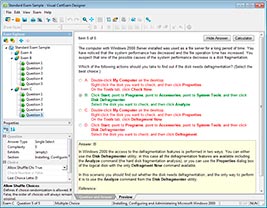
HOW TO OPEN VCE FILES
Use VCE Exam Simulator to open VCE files
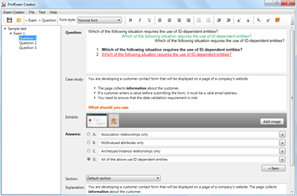
HOW TO OPEN VCEX AND EXAM FILES
Use ProfExam Simulator to open VCEX and EXAM files
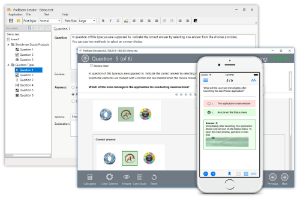
ProfExam at a 20% markdown
You have the opportunity to purchase ProfExam at a 20% reduced price
Get Now!